
Maruti Suzuki Chairman R C Bhargava is pushing for increased government incentives for biogas-powered vehicles over hybrids, emphasising their net-zero carbon emissions and the valuable organic manure they produce, while also advocating for continued GST benefits for electric vehicles.
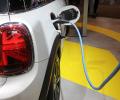
Maruti Suzuki India will launch electric vehicles in the country only after 2025 as demand for such vehicles at the moment is less and it would like to sell around 10,000 units a month whenever it enters the electric mobility space, company chairman RC Bhargava said on Wednesday. Addressing a virtual conference on the company's second quarter earnings, he said under the current circumstances a lot of things in the EV ecosystem such as batteries, charging infrastructure and electric supply are done by other parties and therefore the costing is not in the hands of the company. Also with fuel prices going up, car market leader Maruti Suzuki India is intensifying its focus on more CNG offerings of its models.
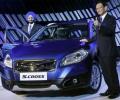
Speaking after the meeting, Maruti Suzuki chairman R C Bhargava said the company will export 'Baleno' at the moment

The country's largest carmaker Maruti Suzuki India is recalibrating production of its upcoming model e-Vitara due to the shortage of rare earth magnets, industry sources said. The auto major is looking to produce around 8,000 units of the model by September as against the earlier stated plan of rolling out over 26,000 units during the period.
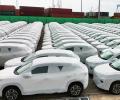
"My understanding is that the rules are weighted in favour of big cars, even though smaller cars emit fewer emissions per passenger, use less material, and consume less fuel," Bhargava said in an interview with Business Standard.

With the government not continuing with lower excise duty beyond December 31, major car makers, including Maruti Suzuki, Hyundai, GM India and Honda have raised vehicle prices by up to Rs 127,000.

Auto major Maruti Suzuki India on Friday said its consolidated net profit declined by 1 per cent year-on-year to Rs 3,911 crore in the fourth quarter ended March 31, 2025, on account of higher expenses. The country's largest carmaker reported a net profit of Rs 3,952 crore in the January-March quarter of FY24.
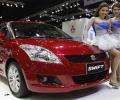
Maruti Suzuki growing in double-digits; Suzuki's Japan Q1 top line rose only 1%.

Maruti Suzuki India's net profit surged 80.3 per cent to Rs 3,716.5 crore in the September quarter, driven by better sales, softening commodity prices, cost reduction efforts and higher non-operating income. The company had delivered a net profit of Rs 2,061.5 crore in the year-ago period, Maruti Suzuki India said in a statement on Friday. Maruti said it is expecting the affordability of small cars in the domestic market to come back in the next 2-3 years in the face of rising income levels of people and a growing economy, among others.

"Export will not be better in this fiscal. It will remain more or less the same as last year or may be even worse. Situation in many global markets has not improved yet," Maruti Suzuki India (MSI) Chairman R C Bhargava said on the sidelines of Hero Mindmine Summit.

Ahead of this year's Budget, leading car manufacturer Maruti Suzuki on Monday asked the government not to roll back the entire stimulus package at once as it may hamper economic growth.

The slowdown in growth is an industry-wide trend and companies are adjusting production to bring down the inventory levels at plants as well as dealerships.

The growing rift between MSIL and rival automakers has complicated the government's efforts to finalise the CAFE norms.

Maruti's exports in May were down 2.4% at 9,089 units

MSI chairman R C Bhargava said auto sector would like to see GST benefits linked to greener/cleaner cars. The government gave tax cut on EVs but hybrid should be given duty cut. There should be tax cut on CNG vehicles.

Its production declined for the third consecutive year in financial year 2020-21 (FY21) to an 11-year low, while sales volume contracted for the second year to the lowest since FY15. The company manufactured around 1.08 million vehicles last fiscal, a decline from 1.17 million the previous year, and a steeper fall from its all-time high tally of 1.62 million reported in FY18.

Hyundai, which is also toeing Maruti's lines, said special schemes are offered to engage the cab aggregators, including annual-maintenance-contract packages and extended warranty.

Nissan, Japan's fourth-largest car manufacturer, sells MSIL's A-Star as Pixo, an entry-level car, in Europe.
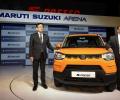
Maruti's strategy for the SUV segment is to arrest the decline in customers for entry level hatchbacks.

The Baleno is among the top selling cars with unserviced bookings of 55,000 units.
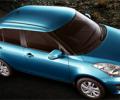
The company had set an annual production target of 250,000 for its Hansalpur plant in Gujarat.
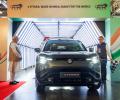
Japanese automaker Suzuki Motor Corporation will invest Rs 70,000 crore in the next five to six years in India to strengthen its operations in the country, its representative director and president Toshihiro Suzuki said on Tuesday. Prime Minister Narendra Modi on Tuesday kicked off exports of Maruti Suzuki India's first electric vehicle e VITARA to 100 countries and also inaugurated the production of lithium-ion battery cells for strong hybrid electric vehicles at its facility in Gujarat.

The country's largest car maker Maruti Suzuki India on Friday reported a 47.8 per cent rise in net profit for the March quarter of FY24 to Rs 3,877.8 crore, on account of higher sales volume and favourable commodity prices.
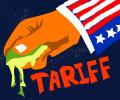
India needs to come together to deal with the 50 per cent punitive US tariffs on Indian products and stand up to any kind of bullying, Maruti Suzuki India chairman R C Bhargava said on Thursday. "It is our duty as Indians to do our very best to promote and maintain our dignity and respect and not give in to any kind of bullying in this matter... the nation has to stand united," Bhargava said at the company's 44th Annaul General Meeting in New Delhi.

Maruti Suzuki India (MSI) on Tuesday said it will not resume full-scale production at its Manesar plant till workers sign a 'good conduct bond', as demanded by the company to ensure there is no repeat of quality issues that have surfaced at the plant.
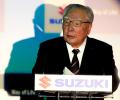
'Without his vision and foresight, his willingness to take a risk that no one else was willing to take, his deep and abiding love for India, the Indian automobile industry could not have become the powerhouse that it has become.'
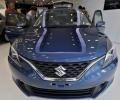
The domestic car sales volume of the company is also growing at 15%
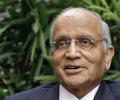
The government should not be running businesses as public sector companies are inefficient and do not generate enough resources to fund their own growth, according to Maruti Suzuki India chairman R C Bhargava. Public sector companies need support all the time to grow and need funds from the government for capital investments, he told PTI in an interview. "I have no doubt that government should not be in business. No way," he said when asked if governments should be in the business of running enterprises on the basis of his experience of witnessing the transformation of the then government-owned Maruti Udyog Ltd to Maruti Suzuki India Ltd, majority owned by Japan's Suzuki Motor Corporation.

India's biggest car maker Maruti Suzuki said on Tuesday that its vehicle production in September will tumble by 60 per cent due to chip shortage. The company, which had earlier cut down production at its Gujarat plant, said the chip shortage will hit production in Gurugram and Manesar plants, effectively forcing the automaker to cut production by 60 per cent. Owing to a supply constraint of electronic components due to semiconductor shortage, the company is expecting an adverse impact on vehicle production in September in both Haryana and its contract manufacturing company, Suzuki Motor Gujarat Pvt Ltd. (SMG) in Gujarat.
Osamu Suzuki, chairman, Suzuki Motor Corporation, is likely to meet Gujarat Chief Minister Narendra Modi to finalise plans to set up a manufacturing plant for Maruti Suzuki India.
Maruti Suzuki chairman RC Bhargava has said that reducing carbon emissions does not require making a choice between hybrid and electric cars, and that both can play key and complementary roles if the government wants to achieve its aggressive emissions target. Responding to the fact that the sales numbers of hybrid cars have been higher than electric cars in the last quarter of 2024, Bhargava pointed out: "It has never been about electric versus hybrid. "Both have a clear role to play. By 2030 we expect electric car penetration to be around 20 per cent.
Car purchases in India are largely limited to the top 12 per cent of households with an annual income exceeding Rs 12 lakh, while even small cars have become unaffordable for the remaining 88 per cent, said R C Bhargava, chairman of Maruti Suzuki India Limited (MSIL), on Friday. "How can you get high car sales growth if 88 per cent of the country are below the levels of income where they cannot afford these cars costing Rs 10 lakhs and above?
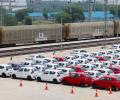
Companies with "gas guzzlers" are trying to set up the wrong narrative against small cars getting relaxation in the proposed corporate average fuel efficiency (CAFE-III) norms on the basis of weight, Maruti Suzuki senior executive officer corporate affairs Rahul Bharti said on Monday, bringing to the fore deep division among carmakers regarding the upcoming rules.

Net sales during the reported quarter rose to Rs 20,594.3 crore, up 14.4 per cent against the year-ago period.
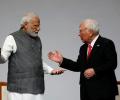
Osamu Suzuki, the man who took a risk and bet on India when no one else believed in having a viable automobile company in the country, has died at the age of 94, according to information shared by Japan's Suzuki Motor Corporation on Friday.

Maruti Suzuki exported 1,47,000 units in 2008-09, the highest ever export figures, with the compact car A-star alone clocking over 1,27,000 units.
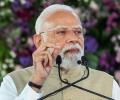
A day before US President Donald Trump's additional 25 per cent tariff kicks in, Prime Minister Narendra Modi on Tuesday made a vehement pitch for swadeshi and Make in India that should help create jobs in the country.

'GST reduction will help larger and high-end cars too.'
Shares of Maruti Suzuki tanked over 5 percent last week on concerns related to its plant in Gujrat. However, its chairman says, company will deliver good results in ensung quarters.
The country's largest carmaker Maruti Suzuki India will not "walk away" and fight to get back to 50 per cent market share in the domestic passenger vehicle segment, according to company Chairman R C Bhargava. The auto major, which is commemorating 40 years of operations, has seen its market share drop to 43.38 per cent in FY22 from a peak of 51.21 per cent in FY19. In order to get back its dominant leadership, the company plans to drive in models catering to both urban and smaller cities and rural areas.
